News
Updated the latest activities and news from CityLand.


(Doanhnhansaigon.vn) After a prolonged period of stagnation, Vietnam’s real estate market is entering 2025 with clear expectations of recovery, propelled by five core drivers: economic rebound, an improved legal framework, accelerated digital transformation, product diversification, and a strong surge in public investment.
From 2022 to 2023, the Vietnamese real estate market endured a particularly challenging phase marked by high interest rates, tightened credit conditions, and a sharp decline in investor confidence. However, as 2025 approaches, the market outlook is gradually brightening, thanks to the combined impact of five key forces that businesses and experts alike describe as a long-awaited “catalyst” unlocking the market after an extended downturn.
According to the latest survey by Vietnam Report, 73.3% of real estate enterprises believe that the pace of economic recovery will be the most decisive factor shaping the market landscape in 2025.
In reality, following a difficult period, Vietnam’s economy recorded a 7.09% growth rate in 2024, sending a strong positive signal for recovery momentum.
Associate Professor Dr. Trần Kim Chung, former Deputy Director of the Central Institute for Economic Management Research, commented: “In 2024, the real estate market entered a new development cycle—the phase of financialization. Market institutions have been comprehensively revised and improved. Transactions and prices in the apartment segment in Hanoi and several localities have begun to show signs of recovery.”
Looking ahead to 2025, Dr. Chung added: “With a stable macroeconomic environment, the real estate market will also remain fundamentally stable. According to the 10-year real estate cycle, 2025 is a year in which the market stands to benefit significantly from macroeconomic policies.”
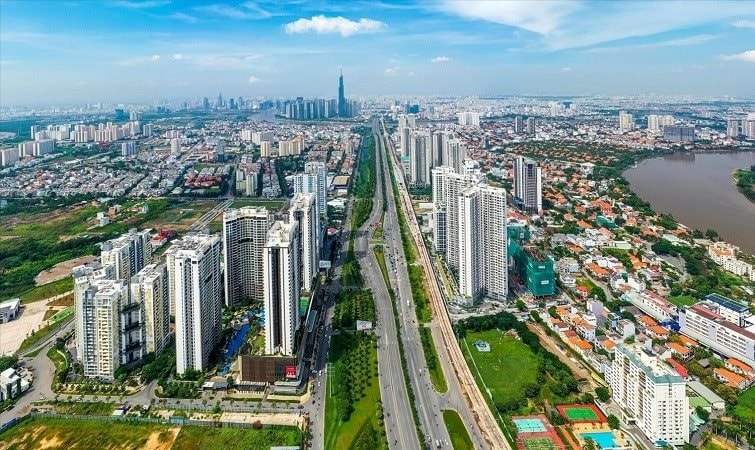
Entering 2025, the Government has set an ambitious GDP growth target of 8%, with aspirations of achieving double-digit growth in subsequent years. Although the inflation target has been adjusted upward to 4.5%, the stable macroeconomic environment is still expected to stimulate consumption and investment, providing strong momentum for the real estate market—particularly in segments serving genuine housing demand, including mid-range and affordable housing in major urban centers.
In parallel, continued inflows of foreign direct investment (FDI) into industrial zones are driving substantial demand for housing for workers and experts, thereby energizing both industrial real estate and social housing segments.
Ranked second among market drivers is the legal environment, with 62.2% of surveyed enterprises highlighting the positive impact of amendments to three cornerstone laws: the Housing Law, the Law on Real Estate Business, and the Land Law, all of which officially came into effect in August 2024.
In the short term, these revised laws have helped unblock numerous projects previously stalled due to legal bottlenecks—one of the main causes of severe supply shortages in recent years. In 2024 alone, 210 projects were “rescued”, most of them residential developments in Hanoi, Ho Chi Minh City, and Da Nang
Over the longer term, the new legal framework is expected to bring about profound structural changes. The revised Land Law expands land access for foreign investors and overseas Vietnamese, while the Housing Law prioritizes the development of social housing through robust incentive policies. Meanwhile, the Law on Real Estate Business imposes stricter requirements on transparency and accountability for developers—a major step toward restoring consumer confidence.
Digital transformation is permeating every sector, and real estate is no exception. From building operations and property management to product distribution, customer relations, and transaction processing, technology adoption is enabling enterprises to reduce costs, improve efficiency, and enhance customer experience.
Notably, digital platforms and big data analytics allow developers to assess market demand more accurately, design products that better match real needs, and mitigate risks related to inventory accumulation and supply–demand imbalances.
In addition to conventional segments such as residential and resort real estate, many developers are actively expanding into new product lines, including logistics real estate, data centers, and rental housing.…
This trend not only helps businesses diversify risk but also positions them to capture emerging market demands—particularly as urbanization accelerates and demographic structures continue to evolve rapidly.
Public investment remains an indispensable “ignition spark” for the real estate market. In 2025, total public investment is projected to reach VND 878.316 trillion, the highest level ever recorded. Major infrastructure projects such as the North–South Expressway, Long Thanh International Airport, Hanoi and Ho Chi Minh City metro systems, and urban ring roads are expected to provide a powerful boost across residential, commercial, and industrial real estate segments upon completion.
Mr. Phùng Hoàng Cơ, Vice Chairman of Vietnam Report, noted: “As infrastructure is completed, urbanization and industrialization will accelerate in emerging areas. This will lead to the formation of satellite urban clusters, ease pressure on major cities and enable the real estate market to develop in a more balanced and sustainable manner.”
Meanwhile, Mr. Nguyễn Văn Đính, Vice Chairman of the Vietnam Real Estate Association, emphasized: “Economic recovery and infrastructure investment policies will continue to stimulate both investment demand and genuine housing demand. A projected GDP growth of 8% will serve as a powerful driver for the entire market.”
With five core growth drivers, alongside decisive action from the Government and the business community, Vietnam’s real estate market in 2025 is not only expected to recover but also to lay a solid foundation for a new growth cycle spanning 2025-2030. Nevertheless, challenges remain. Issues related to information transparency, speculation control and supply – demand balance must continue to be addressed to ensure that the market develops in a healthy, stable and sustainable manner.
Source: doanhnhansaigon.vn